Friday, July 1, 2011

Road Report: I Slept With Frank Lloyd Wright

We were on our way home and we needed one night's lodging.
I had to pick a town and a place to stay.

Hmm, what might prove interesting?

There had been 26 people at our family reunion back in Branson, Missouri, but it was my brother who saw me with my head in the road atlas and made the best suggestion.

"Did you know there's a hotel in the Price Tower in Bartlesville, Oklahoma?"

The Price Tower!

Back Story
Settle yourself into a time machine for just a minute. We're headed to the 1950s.

It's just before the arrival of Buddy Holly and Elvis. Your name is Harold C. Price Sr. and you live in a smallish city in northeast corner of Oklahoma where you own an oil pipeline company and are sitting on personal fortune. In a state where oil has made a few men almost overnight millionaires, you're practically rolling in greenbacks. So what are you going to do with your new-found wealth?

You decide to ask America's most famous living architect to design your home. And why stop there? You ask him to design a high-rise building for your pipeline company as well.


The architect steps in and does the work in his usual fashion. Singular. Memorable. With control of detail right down to designing the carpets, stair rails, grates over the heating vents, and the ceiling lights.


Lobby ceiling with quote from Whitman on the wall.


The aging architect (right)
looking over plans with client Harold Price.


It's all of a piece.

It all goes together.

It bears his inimitable stamp.

This is a building by

Frank

Lloyd

Wright.


Of Trees and Buildings That Scrape the Sky
The Price Tower opened in 1956. Seventeen thousand people lined up over three days for tours. No one had seen anything like it. After all, America had slipped into the age of the smooth sided, unornamented glass tower where symmetry and sleekness were the thing. Everyone was talking about the new U.N. building.


The new architectural champion: straight lines and glass.
Exemplified by NYC's United Nations building.

The Price Tower went against the current architectural grain. There were no right angles. Equilateral triangles abounded, even in the shape of the light covers installed in the ceilings. Copper, which was chemically treated to give it an instant green patina, was everywhere.


The building wasn't about a solid structure to which ornamentation had been applied. No, like a mountain or a sunset, the building itself was the object that entranced the eye.


Another version of "trees" rising from the urban forest,
Antoni Gaudi's Sagrada Familia, Barcelona, Spain.
In the end, the Price Tower was the only skyscraper designed by Wright that would ever be constructed. Like Antoni Gaudi who went lavish and wild with his organically inspired Sagrada Familia cathedral in Barcelona (begun in 1882 and still under construction), Wright thought a building should echo the wonders of nature.

He called the Price Tower "the tree that escaped the crowded forest."

Some thought Wright meant by this that his American skyscraper, whose normal domain ought to be in places like New York City and Chicago, had "escaped" to the humble plains of Oklahoma.

The "escaped" tree thus could be said to now rise pristinely, free of the concrete shadows of its less inspired concrete and steel cousins.

More likely Wright meant exactly what he said. He had set out to design a building that drew its inspiration from a literal tree.


Giant Sequoia Tree
by John Tayson (1978)
watercolor

The Price Tower had floors that "branched" off a central trunk (which held the elevators). And all that deliberately greened copper? It wasn't just an aesthetic whim. Trees have leaves and leaves are green.

In Wright's "tree" people would live and work in in the heart of downtown. They would no longer be divorced from the glories of nature. Their very abode would remind them of the earth.

It is in this very unlikely place with its unlikely building that years later someone came along and turned 21 rooms on the upper floors into one of America's most remarkable hotels.

The Price is Right
Check into the Inn at Price Tower and a friendly gentleman with a stylish beard introduces himself as Art. He asks your names (even the childrens'), shakes everyone's hands, and shows you that the museum and gift shop are right behind the registration desk.

There's great stuff in the museum. The desks and chairs designed by Wright look as if they'd be at home on the bridge of the Starship Enterprise. Really out there!


But let's face it. What you're most anxious to do is hit the up button on the very weirdly shaped elevator (a tight fit if you have a couple of suitcases with you) and get up to 12th floor, run the card key, and open your room.

Wow.


The interiors have been designed by Wendy Evans Joseph. Everything is custom-made: the beds, wardrobes, the desk. The carpet and drapes have been designed and woven for the room. Even the triangular, copper trashcan that exactly fits behind the desk leg and weighs about ten pounds is a one-of-a-kind.


Custom desk

Custom chair

Ms. Joseph has taken Wright's tree idea along with a sense of the clean and the spare and translated it through a Japanese bamboo forest filter. There's lots of copper, too, angled like bamboo stalks.


It's all open, large and inviting.

Even Higher
It isn't bedtime yet, so we head to the 15th floor and the Copper Bar.


Hmm. Let's peruse the menus...


The special house drink is the Coppertini.

Coppertini Recipe:

ketel one, amaretto disaronno, grand marnier


My wife has the Caribbean Kiss. I have a chardonnay.


Checking Out
The next morning we took our breakfast on the 16th floor terrace. Muffins and pastries came to us, warm out of the oven. Eggs and sausage, too. And make your own waffles. I forged a relationship with a machine that dispensed either coffee or a decent facsimile of espresso.

The Inn at Price Tower was making it all that more difficult for us to say good-bye. But my son and I still had a few more photos to take.


Our son (age 13) has for some time said that he wants to be an architect when he grows up. I realize, of course, that often other gifts emerge in a person as they mature. I mainly hope he finds a vocation that pleases and satisfies him. Still, I would love for there to be an architect in our family.

A piece of music goes mute once the instruments are put down. A novel only dimly echoes in the mind when the covers are closed. But a building seems to me as close to a living thing as a human artist can construct. It's there 24/7, inviting us in to wander through its spaces, gaze through its portals, perhaps even to lie down and take our rest.

A good building continues to breathe and persist and return to us at dawn. I suppose that's why it seems to be in our nature as a species to keep putting up walls and stacking stones into monuments. May another genius come along to raise us some more. - V.W.


.

Tuesday, June 28, 2011

Road Report: Tale of the Tree House


He's coming to tow your wallet away...
I can't help it if I know that Cars 2 is about to be released. . . 
Of all the Pixar films, Cars is arguably the most merchandised and heavily promoted. I don't think even the Toy Story films can compare.

Thus Cars 2 has been in my face (and I assume yours) this summer with ads, posters, and verbiage printed on food products.

According to the marketing geniuses behind this phenomenon, I should ready myself to purchase such valuable treasures as the Cars 2 Shower Gel Assortment! And I was hearing about all this before the movie had even come out...

In the midst of this media hucksterism I've tried to be a good Van Winkle and avert my eyes, but it's like trying to ignore the weather. So I've found myself saying, "Oh, never mind" and forgiven my transgressions.

After all, the original Cars wasn't all bad. I liked its tribute to the old Route 66 in the film and also how Tow Mater was the funniest hick of a fellow since "Surprise, surprise, surprise!" Jim Nabors as Gomer Pyle, USMC.

My main problem was that I never bought into the concept of cars whose grilles and bumpers move like mouths and, guess what, they talk!

You see, talking animals I'm fine with. Ditto monsters and plastic toys. I can even suspend disbelief on behalf of talking vegetables. But somehow I can't quite transfer my emotions to a muffler and a fossil fuel burning engine.

Cheesy.

The real reason I mention Cars is that the original film brought to my attention that old place on Route 66 where you can stay in a concrete Indian tepee. I refer to the Wigwam Motel in Holbrook, Arizona. This set me up recently to be primed to try some tepee camping of my own. It happened when I discovered we would be traveling in the vicinity of Diamond John's Riverside Retreat near Murfreesboro, Arkansas.

At Diamond John's you can stay in an air conditioned tepee.

Except this was better than the Arizona place. No concrete here. These were real tepees. Yet they were air conditioned with queen beds and satellite TV, making them semi-comfortable for those of us who inhabit tender skins several generations beyond Geronimo.

Well, I was all set to make a reservation when I discovered I could do even better than the tepee. We could stay in a tree house.


The Peaceable Kingdom
The tree house at Diamond John's is a fine experience, It's not terribly high off the ground as one might imagine, which is good news for acrophobia types. Still,there are real tree trunks passing through the room that the window glass artfully forms a border around. And the view is just great. Which is to be expected. It is a house...in a tree.


But the tree house wasn't the main attraction.


We were able to spend the better part of an evening, a night, and a morning alongside an emerald river.

Domesticated animals came and went. Like...

...the geese who congregated at the foot of our tree house and romanced us with a honking karaoke.

...a couple of goats who trod silently here and there.

...peacocks who moved along, their long plumage swishing behind them.


Up the hill in back of the tree house there were some miniature ponies in a pen begging us to feed them. The hill was important to us since there was one drawback to our lodgings. No plumbing in a tree house. We had to trek up the hill to the bath house to get water and use the facilities.

At night another creature made an appearance. I hadn't seen these in years: fire flies. They popped their lights for us in the dusk like cinders hovering above the ground. A wink and then extinction. Then another one.

Did we sleep well in the tree house? Well, it was kind of bright since we only had sheers for curtains and that night there happened to be a full moon. And our beds squeaked every time one of us turned over. And, wouldn't you know it, we had to get up in the middle of the night to go to the bathroom. Uh oh. A hike up the hill.

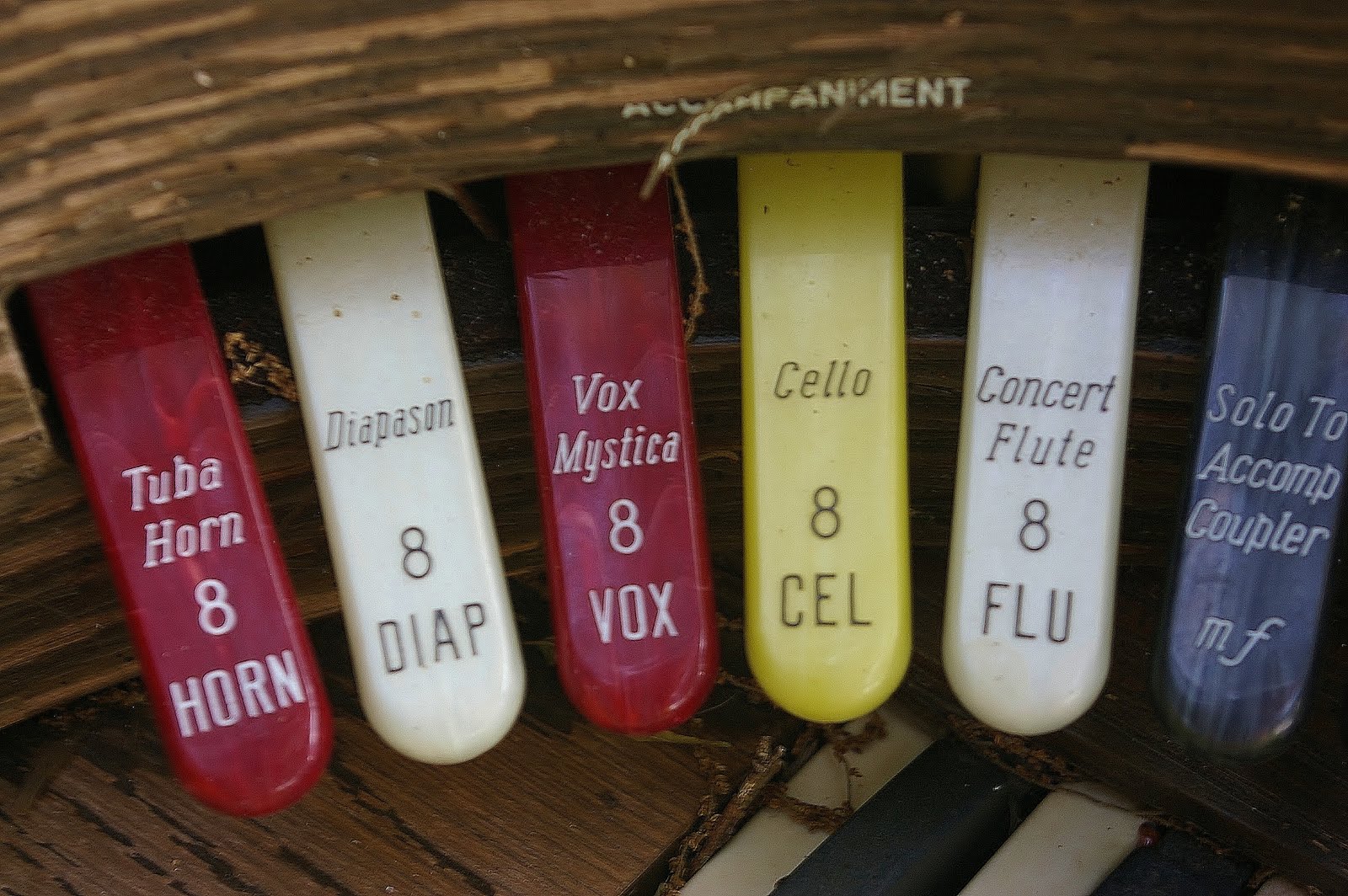
Still, it was an experience unlike any I've ever had. The climax came the next morning when I wandered down by the river and found an old electric organ someone had left to rot among the trees.


I saw words that aptly described what our time had been like.


Yes. It felt as if we had been tuned into the Vox Mystica, that musical voice that resonates right down to the level of blood and bones. Peaceful, peaceful. - V.W.


.

Friday, June 24, 2011

Road Report: Diamond Daze

I now realize there's a good reason why diamonds are so expensive.

It's not just because the little jewels shine so brightly. It's not just because a diamond is so hard that nothing can cut it except another diamond.

It's also because diamonds are darn hard to find.

This might seem already obvious or a commonplace to you. In my case, I had to drive to a locale outside the little burg of Murfreesboro, Arkansas. At Crater of Diamonds State Park I found out firsthand about the rarity of diamonds as we were welcomed into the only place in the world where the public is invited to mine for diamonds.

More, you are told you can keep as many diamonds as you wish. That's right, folks, free diamonds! Just pay the $7 entry fee, rent or bring your own tools, and get to work.

Riches await you.

Maybe.

Since 1979, over 28,000 diamonds have been found in the crater by people just like you and me. Some were found as recently as a few days before our arrival. In a few cases, the diamonds were large, large enough to earn them their own name and a marker out in the crater noting the location of the find. Like the Star of Arkansas and the Uncle Sam diamonds.

Does that sound enticing or not? We set to work.

What I Learned About Diamond Mining
At the visitor center a park ranger gave us a live demonstration of the basics of what we were getting ourselves into. Exhibits and videos provided further information.


Legendary diamond finder James Archer
in his ever present yellow waterproof pants.
I soon realized that with our mild foray into diamond digging we were unlikely to become very adept at identifying the best digging spots and gravel with the highest potential to yield diamonds, In other words, there was no comparison between us and the Crater of Diamond's own legend, Mr. James Archer.

James rated his own display at the visitor's center. He spent decades at the crater, even into his retirement years, and he found over 7,000 diamonds.

James was famous not just for his finds, but for his friendliness and willingness to help others dig. James died out in the crater doing his favorite thing. Digging for diamonds. He was 78 years old.

As we stood in line to rent equipment I was armed with further information: most diamonds are extremely small and not that impressive looking. Some are yellow or brown. All of them look like little pieces of polished glass. The samples we saw in the display case in the visitors' center had been about the size of fingernail clippings.

What we were searching for...
Even though we were told diamonds had been found by children looking down at the dirt and seeing something sparkling in it, the usual method of prospecting involves digging up dirt and then sifting through it. There are two methods of sifting: dry and wet. In either case we had to take our two sifter screens (one coarse, one fine) and shake the dirt through it and then inspect what was left behind.

Right away I knew I favored the wet method. The wet method would lead us to the washing troughs at the edge of the crater. The troughs were covered by metal roofs. We could find our treasure in the shade.

Hotter Than
We began by filling a bucket with dirt from the crater. "Crater" is perhaps too dramatic of a word. The mining area was a plowed field consisting of rough dirt clods and gravel. The sun was burning down. A park ranger broadcast heat stroke warnings over a loudspeaker. Apparently if we felt dizzy or nauseated and it wasn't from the sight of a diamond the size of a hen's egg, we should seek immediate medical attention.


The diamond crater.


Sifting.

After filling it up with shovelfuls of pre-sifted dirt, I lugged our heavy bucket to the washing area and began working at the trough.


At the washing station...

A half hour later I had...a few flecks of quartz, hardly any bigger than a pepper flake.

A Dazzling Finale?
It soon became pretty obvious to me. For a person to find a diamond he or she had to be either very, very lucky or sift a lot of dirt. It really was akin to finding a needle in the proverbial haystack. Sure, you might find the needle the first time you thrust your hand into the hay. More likely you would have to search the entire haystack over and over, ad infinitum. In the meantime, someone else who is either luckier or tries harder than you, may find the needle first.


Hmm. I'm not seeing any diamonds here...just dirt!

By the end of the afternoon it had occurred to me that mining for gems and precious metals is perhaps a bit like seeking love. Yes,it can be frustrating on the bleakest days when we're surrounded by a hot, blasted barren field, seemingly bereft of possibilities. Still, it's the hope of having success that leads most of us to become what Mr. Neil Young once described in song as being a "miner for a heart of gold." We keep on digging.

If we can just find that rare, lasting, durable love to end all loves, all of the sweat and dirt clinging to us will wash away and our labors will be justified.

You can walk onto the field and hope to get lucky in an hour or you can be like James Archer and keep on digging six days a week, year after year. Pure tenacity in service of that hidden, valuable thing.

I think it's the James Archers of this world who have it figured out. - V.W.

Tuesday, June 21, 2011

Road Report: Where There's Hope

We weren't on what the locals call a "Bill-grimage." A Bill-grimage? It's a portmanteau word that has come into play to describe tourists who are ardent fans of William Jefferson Clinton and his two-term presidency from 1992-2000.

As has been noted here before, this is not a blog where political notes are sounded or aired. What can one expect from a guy who is trying to avoid the news? So I'll just say that there were things I surely admired about Bill Clinton's presidency and others that disappointed me and leave it at that.

The real reason we were in Hope, Arkansas, was because it was more or less on the way to where we were going.The fact is that if I happened to be passing by, I'd probably stop off at the home of any U.S. President. From George Washington to Barack Obama, and the William Harrisons and Grover Clevelands in between, all of them have been interesting people.

Often the distance between each of these men's beginnings and where they ended up--as the leader of one of the most influential and powerful nations in history--says a multitude about what makes America a very interesting political and social experiment. "Can anyone grow up to be president?" as we Americans like to claim?

Sometimes it appears so.

You can feel it standing in the fatigued single block of low, stone and brick buildings that constitute downtown Hope, Arkansas.

A U.S. president was born and raised here? A town whose most prominent feature is the railroad station?

It's not hard to imagine that little Billy Clinton heard those passing trains. They rattled and chanted, "Let me take you away from here!"

And it had a magical effect on another man as well. Like little Billy, Mike Huckabee, another Hope resident, moved on to the governor's mansion in Little Rock and his own presidential aspirations. Clinton and Huckabee both from this tick on a mangy dog of a town? What are the odds of that?

I learned about such wonders at the train station museum devoted to Hope, Bill Clinton and watermelons.

Since I wasn't on a Bill-grimage I found myself particularly  interested in the watermelons. They grow them BIG in Hope.


Still, Bill Clilnton's presence couldn't be escaped.


Excuse the ex-president's stiff demeanor.
He's made of cardboard.

The very friendly African-American woman who was in charge of the place said President Clinton was last in Hope this past April 19th. She pointed proudly out the window. "He was walking right on the street right there!"


LOTS of whipped cream!
I wondered if former President Clinton dined at Tailgater's Cafe on the corner. It's a new establishment in Hope and they serve burgers and hotdogs and some seriously fat fries. We tried it out for lunch. The chocolate shakes were particularly noteworthy.

Another feature of this cafe is that they assign your order the name of a famous person and give you a ticket with that name on it. We got "Jack Nicholson." I was kind of disappointed. I wanted someone younger. Maybe "Leonardo Dicapprio." Still, it was better than the alternatives. "Justin Beiber?" Please. Not on an empty stomach.

Health food, Arkansas style...
Of course, Bill Clinton had heart surgery a few years ago, lost a lot of weight, and reformed his famous burger eating diet. Standing in Hope, though, one could see how he'd had been led down the wrong culinary path at an early age. This was standard-issue Heart Cloggage, Heartland, America.

I actually would have liked to have spent more time in Hope. Not for the sake of Bill, but because the town has one other claim to fame.

Here they build Klipsch speakers. These highly regarded (by some) music reproducing devices contain the famous Klipsch horn. The horn (as opposed to cone design) is said by most audiophiles to be outdated and an inaccurate way of producing musical highs. They object that a horn sounds too bright.

I once owned some Klipsch RF-1 speakers. At the time they produced the finest sounds I'd ever heard in my living room. They were especially good at pounding out the drums on rock albums like The Who's Tommy. What I appreciated, too, was that these 48" tall beasts, each weighing 50 lbs., were made in the USA. In Hope, Arkansas.


Klipsch speakers with their distinctive copper
colored speaker cones, horn speaker
at the top...and made in Hope, Arkansas

Short on time, we didn't visit the Klipsch factory, but I noted a pair of Klipschs hanging from the ceiling of the Tailgater's Cafe. I left thinking of giant watermelons, rock 'n' roll, and a burger loving boy who grew up to be president. Mama, please check my temperature. I may have a slight case of patriotism... - V.W.

.

Sunday, June 19, 2011

Road Report: Texarkana, the City that Lays It On the LIne

Foreground: Texas. Background: Arkansas
I'd never been to Texarkana. Wait. Which Texarkana am I talking about? Because there are two.

There's Texarkana, Texas.

There's Texarkana, Arkanasas.

Both are cities with populations between 30,000 and 40,000 people.

And they are separated by an invisible line. But invisibility is not an impediment to appreciating civic distinctions. City fathers long ago sought to make the invisible visible. They built a building and put up a sign.


All you have to do is drive downtown and you'll see the impressive combination Courthouse and Post Office built of stone. One half of this building is in Texas. One half is in Arkansas.

Naturally this has any passerby thinking to himself or herself "Photo-op!"

A person can stand here with a foot in each state.


This is what we did. But that wasn't all there was to it.

At that moment I felt very odd vibrations pass through my body. I reached out and touched the metal longitude/latitude sign. It seemed to be pulsing with electromagnetic energy...


Consider this: On the Arkansas side of the line I was sensing Hope, Arkansas which lies less than a hour down the highway. President William Jefferson Clinton was born there.

On the Texas side of the line I felt faint vibrations of President George W. Bush, born somewhat distantly in Midland, Texas.

Both men from these border states grew up and avoided the major danger to their health and welfare, the Vietnam War. Both were criticized for it, yet both men ended up living for 8 years at 1600 Pennsylvania Avenue. Did these two men from either side of the line have anything else in common? Well, each of them was likable in person with down-home, relatable personalities. Other than that, though.

Two sides of the line.


The yin and the yang.

Maybe this is why I felt so strange standing there doing my awkward straddle.

And it wasn't just political.

I felt other contraries.

Good and bad.


Light and darkness.


Merciful and pitiless.


Love and hate.

I don't like lines. I find it difficult to detect them. I'll think I'm standing in one place and discover that I'm just a few metaphorical inches removed. That slight shift is enough that I'm actually occupying another territory altogether.

For example, I think I have the smartest idea since that touchstone for my parents, sliced bread! No,turns out  my idea only feels original because it's so dumb  it's never even occurred to anyone before I came along.

Or I think there's a passionate angel whispering in my ear, but it's some devil of unalloyed selfishness.

But don't let this brief philosophical digression mislead anyone. I wasn't trying to discover whether Texas or Arkansas is the better state and then jump to that side of the line. A few minutes later we drove into Arkansas. After all, this is America. If all the red, white and blue flags I kept seeing flying in front of homes and businesses could have spoken words to go with their snapping in the wind, they might have intoned, "It's all good." Isn't that how one wants to feel about one's country?

What I worried about post-Texarkana wasn't the state of the nation, but the state of me. What I'd remembered back there in front of the Courthouse/Post Office is that there's always a line going through the middle of me. It can be a bit disturbing to carry the image futher--to start to visualize the little journeys I make back and forth across that line.

Thoughtful me, thoughtless me.

Gentle me, violent me.

Creative me, mediocre me.

Energetic me, slothful me.

Good me, bad me.

Maybe that's what impelled me a ways down the highway to throw the steering wheel to the right. We took the exit. We were headed to a place called "Hope." - V.W.

TO BE CONTINUED...

.